
Fence Permit Rules: Height, Setbacks, and Property Lines Explained
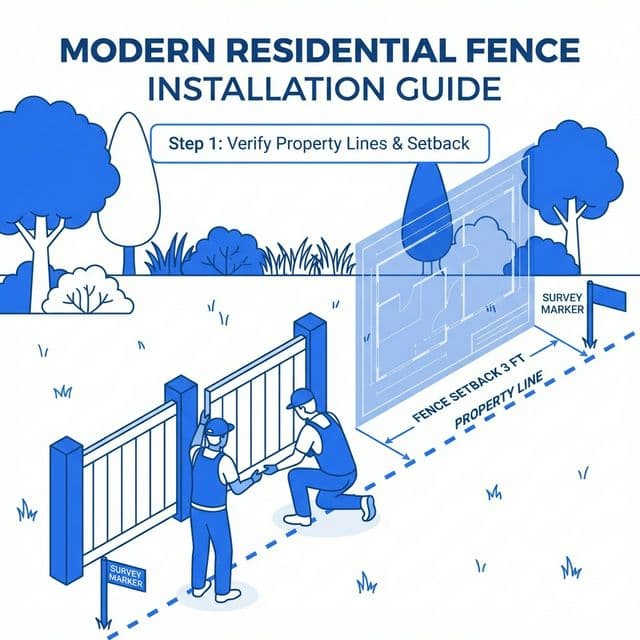
Direct Answer: Most U.S. communities regulate fences through local zoning rather than the building code, and fence permit rules usually turn on four things: how tall the fence is, which yard it sits in (front yards are typically limited to a lower height than side and rear yards), how far it sits from your property line and any road right-of-way, and whether your lot has a special condition like a corner, a shoreline, or a historic overlay. Whether you need a permit depends entirely on your municipality—some require a zoning or fence permit for any fence, some only above a height threshold (often around 6 or 7 feet), and some require none at all for a typical residential fence. Always confirm the exact height limits, setbacks, and permit requirement in your local zoning ordinance for your specific zoning district before you build, because these values are set locally and are not standardized nationwide.
Key Takeaways
- Fence permit rules are mostly local zoning rules, not national building code—so the answer genuinely changes from one city or county to the next.
- Height limits usually differ by yard: front-yard fences are commonly held to a lower limit (often around 3–4 feet) while side and rear fences may be allowed higher (often around 6 feet), but the exact numbers are local.
- A permit may or may not be required. Many places require a zoning/fence permit regardless of height; others only above a threshold; some exempt typical residential fences entirely.
- Corner lots and driveways often trigger a "vision triangle" (sight-distance) rule that caps fence height near intersections so drivers can see.
- The road right-of-way is usually wider than the pavement, so a fence built to the "edge of the road" can illegally sit on public land—your survey and the plat matter.
- Waterfront, floodplain, wetland, and historic-district lots add another layer of rules; in Wisconsin, shoreland zoning under Wis. Admin. Code ch. NR 115 governs the area near lakes and streams.
- Your true property line—confirmed by a survey, not a guess—is the single most common source of fence disputes and forced removals.
On This Page
Jump to any section of this guide:
- What "Fence Permit Rules" Actually Means
- When a Fence Permit Is Usually Required (and When It Isn't)
- Fence Height Limits: Front vs. Side vs. Rear
- Setbacks, Property Lines, and the Road Right-of-Way
- Local Variables That Change the Answer
- Documents and Facts to Gather Before You Build
- Common Mistakes
- Example Scenarios
- Practical Checklist
- Definitions
- Why Local Rules Change the Answer
- A Local Example: Sturgeon Bay, Door County, Wisconsin
- How GovCodex Helps
- Frequently Asked Questions
What "Fence Permit Rules" Actually Means
When people search for fence permit rules, they're usually asking two different questions at once: Do I need permission to build this fence? and What does the fence have to look like and where can it go? Those are governed by two different bodies of regulation.
The first—permission—is the permit question. A permit is a local government's formal sign-off that your project meets the rules before you build it. For fences, the relevant permit is often a zoning permit or a dedicated fence permit, not a structural building permit, because a typical residential fence is not a habitable, wired, plumbed, or heated structure.
The second—what and where—is the standards question, answered by your municipality's zoning ordinance. Zoning is where height limits, setbacks, corner-lot sight rules, and material or transparency requirements live.
Here's the catch that trips up most homeowners: there is no single national fence rule. The International Building Code (IBC) and International Residential Code (IRC) generally exempt many fences from a building permit below a height threshold (commonly cited around 6 or 7 feet), but that exemption from a building permit does not exempt you from local zoning. So a fence can be "code-exempt" structurally and still require a zoning permit, still violate a height limit, and still have to move off the right-of-way. Treat the building code and the zoning ordinance as two separate gates.
Why it matters
A fence built on the wrong side of any of these lines is expensive to fix. The realistic risks are: a stop-work order or a citation; a requirement to lower, move, or tear out the fence; a denied real-estate sale because the fence encroaches; and neighbor disputes that escalate into surveys, easement claims, or litigation. Because a fence is permanent-feeling but cheap to start, people often build first and check later—exactly backward. A few hours confirming the rules is far cheaper than rebuilding a 150-foot fence two feet to the south.
When a Fence Permit Is Usually Required (and When It Isn't)
There is no universal trigger, but the common patterns look like this:
| Situation | Permit usually required? | Why |
|---|---|---|
| Standard residential fence under the local height limit | Sometimes — many cities require a zoning/fence permit anyway | Cities use the permit to check setbacks and corner sightlines |
| Fence over the building-code height threshold (often ~6–7 ft) | More likely — may add a building permit | Tall fences can become structural / engineered walls |
| Fence in a front yard or near a corner | Often | Vision-triangle and front-setback review |
| Retaining wall combined with a fence | Often | Retaining walls over a height (commonly ~3–4 ft) are engineered structures |
| Fence in a shoreland, wetland, or floodplain area | Frequently, with extra review | Overlay rules and state shoreland standards apply |
| Fence in a historic district | Frequently | Design review / certificate of appropriateness may apply |
| Electric, barbed-wire, or razor-wire fence | Depends; sometimes prohibited in residential zones | Safety and nuisance rules |
The honest takeaway: assume nothing. "My neighbor didn't get a permit" is not evidence that none is required—it may just mean they didn't, and they may be cited later. To learn more about how permit categories differ, see the difference between building, zoning, electrical, and plumbing permits. If your fence is one piece of a larger backyard project—say, alongside a new shed or deck—the permit picture can change, so it helps to check when a DIY project becomes a code problem too.
Fence Height Limits: Front vs. Side vs. Rear
The most common structure in residential fence ordinances is a split height limit by yard:
- Front yard / street-facing setback area: the lowest limit, frequently in the 3–4 foot range, often with a transparency requirement (e.g., open/picket rather than solid) so the fence doesn't wall off the street.
- Side and rear yards: a higher limit, frequently around 6 feet, sometimes more for solid privacy fences.
- Above the local building-code threshold (often ~7 feet): may push you into a building permit and possibly structural detailing.
These bands are typical, not guaranteed. Your district's exact numbers are in your zoning ordinance's fence section or accessory-structure standards. Don't copy a neighbor's fence height on faith—their lot may be zoned differently, or their fence may predate a code change and be legally "grandfathered."
The corner-lot vision triangle
Corner lots get a special rule almost everywhere: a vision triangle (also called a sight triangle, sight-distance triangle, or corner clearance). Within a triangle measured back from the intersection of two streets—and often at driveway/alley approaches—fences, hedges, and other visual obstructions are capped at a low height (commonly around 2.5–3.5 feet) so drivers can see cross-traffic and pedestrians. The triangle's dimensions and height cap are set locally. If you own a corner lot, this is the first rule to check, because it can override your normal side-yard height.
Setbacks, Property Lines, and the Road Right-of-Way
Three spatial concepts decide where a fence can go.
1. Property line. Many ordinances let a fence sit on or very near the property line, but "near the line" assumes you actually know where the line is. You usually don't from eyeballing it. A recorded survey or the plat is the only reliable source. If the most recent survey is old or missing, a new boundary survey is the cleanest way to avoid an encroachment. For the broader concept, read what is a setback and why it matters.
2. Setback. Some communities require fences to sit back a small distance from the line (for maintenance access or so footings stay on your land), and front-yard fences frequently must respect the front-yard setback line. Setbacks for fences are usually smaller than for buildings, but they exist.
3. Right-of-way (ROW). This is the big one homeowners miss. The public road right-of-way is almost always wider than the visible pavement—it commonly extends several feet (sometimes 10–15 feet or more) past the curb or edge of asphalt, covering the area where sidewalks, utilities, and snow storage live. A fence built to the "edge of the road" can sit squarely on public land and be ordered removed at your expense. Your plat, a survey, or the municipal ROW/GIS map shows where the ROW line is. Learn how to find these layers in how to read a zoning map before you build.
Local Variables That Change the Answer
Several lot-specific conditions can override the general rules:
- Zoning district & overlays. Residential, agricultural, and mixed-use districts can each have different fence standards; overlay districts (historic, shoreland, floodplain) stack additional rules on top.
- Corner / double-frontage / flag lots. These have more than one "front," so more of the lot may fall under the stricter front-yard rule.
- Shoreline / waterfront. Lots near lakes, rivers, and streams often fall under shoreland zoning, which limits structures, vegetation removal, and impervious surface near the water.
- Floodplain & wetland. A fence in a regulated floodway can obstruct flow and may be restricted; wetlands add state/federal review.
- Historic district. Design review may dictate material, style, and height regardless of the base zoning.
- Easements. A utility or drainage easement crossing your yard can prohibit a permanent fence, or require it to be removable, even if zoning would otherwise allow it.
- HOA / deed restrictions. Private covenants run in addition to public rules and can be stricter.
If your fence sits next to other backyard structures, those carry their own permit triggers—see can I build a garage or shed in my backyard for how accessory-structure rules interact with the same setback and overlay layers.
Documents and Facts to Gather Before You Build
You can answer most of the fence question yourself with the right documents:
- Your property survey or recorded plat — to locate property lines, easements, and the ROW line.
- Your parcel record / GIS map — parcel ID, dimensions, zoning district, and overlays.
- The municipal zoning ordinance — the fence/accessory-structure section for height, setback, material, and vision-triangle rules. (How to find your local building code walks through locating these.)
- The permit application & fee schedule — to learn whether a zoning or fence permit is required and what it costs.
- Any HOA covenants and recorded easements — for private restrictions.
- Overlay maps (shoreland, floodplain, historic) — if your lot is near water, in a flood zone, or in a designated district.
Common Mistakes
- Assuming "no permit needed" from a building-code exemption. Zoning still applies.
- Trusting the visible road edge as the property line. The ROW is usually wider.
- Copying a neighbor's fence. Different lot, different rules, possibly grandfathered.
- Ignoring the corner vision triangle on a corner lot.
- Forgetting easements—a fence over a buried utility line can be torn out by the utility with no compensation.
- Skipping the survey and relying on old fence posts or "where the grass changes."
- Overlooking shoreland/floodplain/historic overlays on waterfront or older-neighborhood lots.
Example Scenarios
Scenario A — Standard interior lot, 6-foot privacy fence in the back. In many residential districts this is allowed at the side/rear height limit. The homeowner still confirms whether a zoning permit is required, checks for a drainage easement along the rear line, and keeps the fence and footings on their side of the surveyed line.
Scenario B — Corner lot. The owner wants a 6-foot fence wrapping the side street. The vision triangle near the intersection caps height to roughly 3 feet within that zone, so the design steps down near the corner and rises to full height farther back.
Scenario C — Waterfront lot. A lakefront owner wants a fence toward the water. Shoreland rules may restrict structures and vegetation removal within a buffer near the ordinary high-water mark, so the fence is set landward of the protected zone and checked against the county's shoreland ordinance.
Practical Checklist
- Pull your survey/plat and confirm property lines, easements, and ROW.
- Identify your zoning district and any overlays from the parcel/GIS map.
- Read the fence section of your zoning ordinance: height by yard, setbacks, materials, vision triangle.
- Determine whether a zoning/fence permit and/or building permit is required, and the fee.
- If waterfront/floodplain/historic, check the overlay rules and any state shoreland standards.
- Check HOA covenants and easements.
- Draw a simple site plan showing the fence line, heights, and distances to property lines and the ROW.
- Submit the application (if required) and keep the approval before building.
For a deeper document list, see the permit application checklist for home renovations, and to budget the cost, how much does a building permit cost.
Definitions
- Zoning ordinance — The local law governing land use, including where structures may go and how tall they may be.
- Setback — The minimum required distance between a structure (or fence) and a property line or street.
- Right-of-way (ROW) — Public land along a road, usually wider than the pavement, reserved for the road, utilities, and sidewalks.
- Vision (sight) triangle — A defined area near intersections/driveways where fences and plantings are height-limited to preserve sightlines.
- Property line — The legal boundary of your parcel, reliably established only by a recorded survey or plat.
- Easement — A right for someone else (often a utility) to use part of your land, which can restrict permanent fences.
- Overlay district — Extra rules layered on top of base zoning (e.g., shoreland, floodplain, historic).
- Shoreland zoning — Rules governing development near lakes, rivers, and streams; in Wisconsin set by Wis. Admin. Code ch. NR 115.
- Ordinary high-water mark (OHWM) — The point on a shoreline that marks the limit of regular water action; many shoreland setbacks measure from it.
- Grandfathered (legal nonconforming) — An existing fence that predates a rule and is allowed to remain even though it wouldn't be approved today.
Why Local Rules Change the Answer
A fence's legality is decided by a stack of jurisdiction-specific layers, which is why no national answer exists:
- Municipality vs. county. Inside city limits, the city zoning ordinance usually controls; in unincorporated areas, the county ordinance controls. They set different height limits, setbacks, and permit triggers.
- State code adoption. States adopt and amend building codes differently, and many delegate fence regulation entirely to local zoning. In Wisconsin, one- and two-family dwellings are built under the state Uniform Dwelling Code (SPS 320–325), while site features like fences are typically governed by local zoning and, near water, by shoreland rules.
- Zoning district & overlay. Your specific district (and any historic, shoreland, or floodplain overlay) changes the numbers.
- Parcel geometry & easements. Corner, double-frontage, flag, and waterfront lots, plus recorded easements, change where a fence can legally sit.
- Project attributes. Height, material, whether it's combined with a retaining wall, and whether it's electrified all change the permit picture.
So instead of "call your city," gather the named artifacts: your recorded survey/plat, the parcel/GIS record (for zoning district and overlays), the fence/accessory-structure section of the zoning ordinance, the permit application and fee schedule, and any shoreland, floodplain, or historic overlay maps. Those documents answer the question directly. Only contact the zoning office when a value is genuinely ambiguous or absent from the published code.
A Local Example: Sturgeon Bay, Door County, Wisconsin
Sturgeon Bay is an incorporated city and the county seat of Door County, Wisconsin. Here's how the general framework maps onto a real place—with the general rule clearly separated from what we could verify locally.
General rule: Inside city limits, fence height, setbacks, and any permit requirement are set by the City of Sturgeon Bay zoning ordinance, published in the city's Code of Ordinances. The city's municipal code is hosted on Municode, and Building Inspections sits within the city's Community Development Department (City of Sturgeon Bay, 421 Michigan Street, Sturgeon Bay, WI 54235; (920) 746‑2900).
What we could verify:
- The city maintains its Code of Ordinances on Municode and provides zoning maps and a fee schedule through its official site.
- Door County provides public land records / GIS web maps and property-tax records, which matter because Sturgeon Bay sits on the water and many parcels are near the shoreline; county-level shoreland zoning is mandated by state law (below).
Shoreland layer (state rule that flows down to the county): Wisconsin's shoreland zoning standards in Wis. Admin. Code ch. NR 115 apply within shoreland areas—generally 1,000 feet from a lake/pond/flowage and 300 feet from a river or stream (or to the floodplain edge, whichever is greater) per NR 115.03(8). The code sets a 75-foot structure setback from the ordinary high-water mark (reducible to the average setback of adjacent principal structures, but never below a 35-foot minimum) under NR 115.05(1)(b)1., a 35-foot minimum vegetative buffer zone measured inland from the OHWM under NR 115.05(1)(c)2., and a standard allowing counties to permit up to 15% impervious surface for riparian lots within 300 feet of navigable water under NR 115.05(1)(e)2. Counties must adopt shoreland ordinances for unincorporated shorelands under Wis. Stat. § 59.692. A waterfront fence near a Sturgeon Bay shoreline should be checked against the applicable county shoreland ordinance and these state standards in addition to city fence rules.
Marked unknown (needs_research): The specific city fence height limits (front vs. side/rear), the exact corner vision-triangle dimensions, the precise fence setback values, and whether the City of Sturgeon Bay requires a dedicated fence or zoning permit were not verifiable from the sources retrieved for this article and are marked needs_research. These should be confirmed in the city's current zoning ordinance section on fences and the city's permit/fee schedule before building. (Note: rules and values can change; verify against the current code.)
How GovCodex Helps
GovCodex is a local-code-aware planning and permitting assistant—not a generic chatbot. For a fence project, it can help you move from "I want a fence" to "I understand the rules, documents, and next steps for my parcel":
- Identify permit triggers for your address by surfacing the local fence and zoning provisions that likely apply.
- Interpret local code in plain English—height-by-yard limits, setbacks, vision triangles, and overlay rules.
- Gather the right facts—zoning district, overlays, easements, and right-of-way—using parcel and GIS context.
- Upload your survey, plat, photos, or a PDF and have GovCodex read them to flag property-line and ROW issues.
- Build a permit-readiness checklist tailored to your jurisdiction and lot.
- Draft project descriptions and site-plan notes you can reuse on an application.
- Compare options—for example, stepping a corner fence down through the vision triangle vs. relocating it.
- Flag missing information and clearly separate confirmed facts from assumptions, so you know what still needs verification.
- Find the right application form and outline localized next steps, with human-in-the-loop review where a value is uncertain or a sign-off is required.
Describe your project, upload any site documents or photos you already have, and GovCodex can help organize the rules, documents, and next steps for your property.
Frequently Asked Questions
Do I always need a permit to build a fence?
Not always. Many communities require a zoning or fence permit for any fence, others only above a height threshold, and some exempt typical residential fences entirely. The building code may exempt a fence below a certain height from a building permit, but local zoning can still apply. Confirm the requirement in your municipality's zoning ordinance and permit schedule for your specific district.
How tall can my fence be?
It depends on the yard and your local code. Front-yard fences are commonly limited to a lower height (often around 3–4 feet, sometimes with a transparency requirement), while side and rear fences are frequently allowed higher (often around 6 feet). These are typical patterns, not guarantees—your exact limits are set by your local zoning ordinance.
What is a vision triangle on a corner lot?
A vision (or sight) triangle is an area near a street intersection—and often at driveways—where fences, hedges, and other obstructions are height-limited so drivers can see cross-traffic. The triangle's size and the height cap (often roughly 2.5–3.5 feet) are set by local code. Corner-lot owners should check this rule first because it can override the normal side-yard height.
Can I build my fence right on the property line?
Many ordinances allow a fence on or near the property line, but you must know where that line actually is. Rely on a recorded survey or plat rather than eyeballing it. Some places require a small setback, and a fence over the line can be treated as an encroachment that you may have to move.
How do I find my real property line?
The reliable sources are a recorded boundary survey or the subdivision plat, supported by your parcel/GIS record. Visible cues like old fence posts, hedges, or "where the grass changes" are not authoritative. If no recent survey exists, a new boundary survey is the cleanest way to avoid an encroachment dispute.
What is the road right-of-way and why does it matter?
The right-of-way is public land along a road, and it is usually wider than the visible pavement—often extending several feet past the curb or asphalt edge. A fence built to the "edge of the road" can sit on public land and be ordered removed at your expense. Check your plat, survey, or the municipal ROW/GIS map before placing a fence near the street.
Are the rules different for a waterfront fence?
Often, yes. Lots near lakes, rivers, and streams may fall under shoreland zoning that limits structures and vegetation removal near the water. In Wisconsin, Wis. Admin. Code ch. NR 115 sets standards such as a 75-foot structure setback from the ordinary high-water mark and a 35-foot vegetative buffer. Check the applicable county's shoreland ordinance in addition to city fence rules.
Does a historic district change my fence options?
It can. Properties in a designated historic district may be subject to design review that dictates fence material, style, and height regardless of the base zoning. If your home is in or near a historic district, confirm whether a certificate of appropriateness or design approval is required before you build.
Can my HOA rules be stricter than the city's?
Yes. Homeowners' association covenants and recorded deed restrictions apply in addition to public rules and are frequently stricter on height, material, and color. Meeting your city's zoning requirements does not exempt you from your HOA's rules, so check both.
What about easements crossing my yard?
A utility or drainage easement can prohibit a permanent fence or require it to be removable, even where zoning would otherwise allow it. If you build over a buried utility, the utility may remove the fence to access its lines without compensating you. Identify easements from your survey or plat before placing the fence.
Is a permit needed if I'm just replacing an existing fence?
It depends on local rules and whether you're changing the height, location, or material. Some communities treat a like-for-like replacement leniently, while others require a permit for any new fence. Confirm with your zoning ordinance, especially if the existing fence was grandfathered and your replacement would not meet current rules.
What documents should I have ready before applying?
Have your survey or plat, parcel/GIS record (zoning district and overlays), a simple site plan showing the fence line and heights with distances to property lines and the right-of-way, any HOA covenants and recorded easements, and the local fence ordinance and permit/fee schedule. Waterfront, floodplain, or historic lots should also gather the relevant overlay maps.
Related Articles

The Homeowner's Guide to Zoning Variances
A plain-English guide to how to get a zoning variance: the difference between area and use variances, the unnecessary hardship standard, board of appeals hearings, public notice, fees, and the documents you need to prepare.
When Does a DIY Project Become a Code Problem?
The line between a weekend project and a code problem isn't about how hard the work is — it's about what you touch. Here's how to tell when DIY needs a permit.

How to Read a Zoning Map Before You Build
A plain-English guide to reading an official zoning map: locate your parcel, identify your zoning district and any overlays, and confirm the real rules before you build.