
Deck Footings, Frost Depth, and Code Requirements Explained
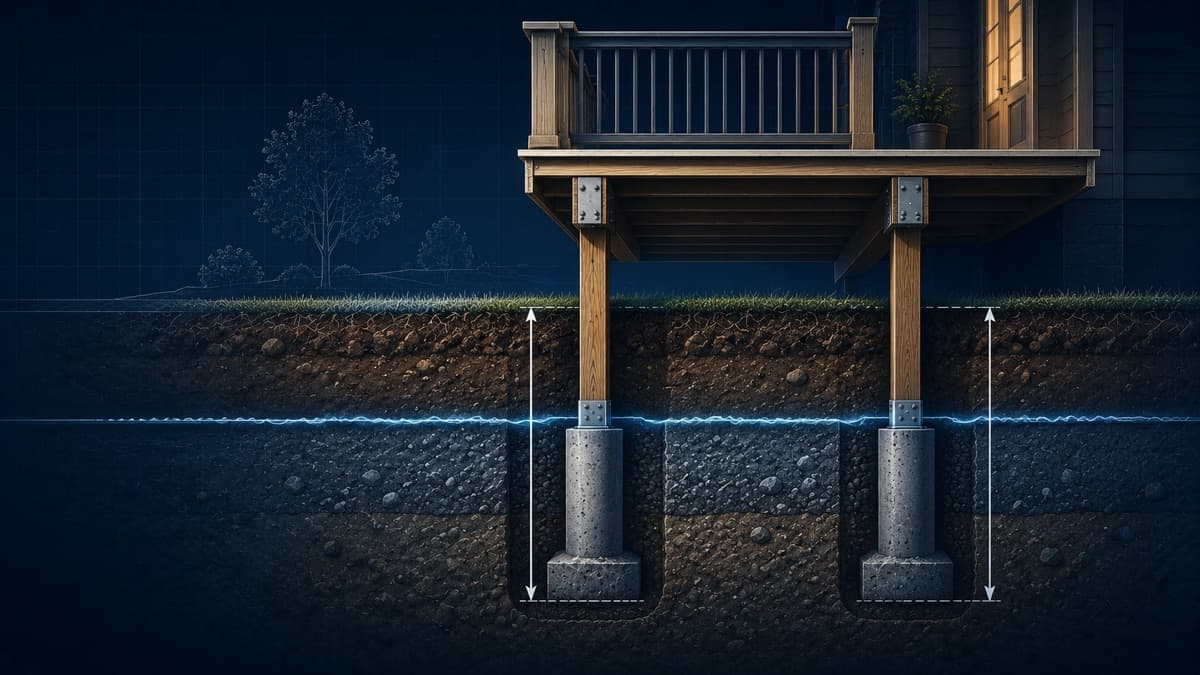
Direct Answer: Deck footing depth is set primarily by your local frost line: footings usually must reach below the depth that soil freezes in your area so frost heave cannot lift them, plus your building code's minimum embedment. In much of the cold-climate U.S. that means roughly 36 to 48 inches deep, and in some far-northern jurisdictions deeper — but the controlling number is whatever your adopted code and local frost-penetration map require, which varies by state, county, and even soil type. Always confirm the exact depth, footing diameter, and whether a permit and inspection are required for your specific parcel before you dig or pour.
Key Takeaways
- The deck footing depth frost line rule exists to stop frost heave: footings generally must bear below the depth your soil freezes, or below your code's stated minimum, whichever is deeper.
- The International Residential Code (IRC) R403 is the common starting point most jurisdictions adopt or amend, but the binding number comes from your locally adopted code and frost-penetration data.
- In cold-climate regions, required depths commonly fall in the 36–48 inch range, and some northern jurisdictions require 48 inches or more.
- Footing diameter (width), post spacing, and load all change together — a hot tub, roof, or snow load increases the bearing area each footing must provide.
- Attached decks must transfer load to (and be flashed against) the house and meet ledger rules; freestanding decks avoid the ledger but still need frost-protected footings.
- Footings are usually inspected before concrete is poured (an open-hole or pre-pour inspection), so scheduling matters — pouring early can force a redo.
- Local variables — soil bearing capacity, shoreland or floodplain overlays, and whether a permit is required — can override the "general" answer for your lot.
On This Page
Jump to any section of this guide:
- What "Deck Footing Depth and Frost Line" Actually Means
- When the Frost-Depth Rule Usually Applies
- Local Variables That Change the Answer
- Footing Depth, Diameter, and Post Spacing — How They Connect
- Documents and Facts to Gather
- Common Mistakes
- Example Scenarios
- Practical Checklist
- Definitions
- Why Local Rules Change the Answer
- A Local Example: Sturgeon Bay, Door County, Wisconsin
- How GovCodex Helps
- People Also Ask
- Frequently Asked Questions
What "Deck Footing Depth and Frost Line" Actually Means
A deck footing is the concrete base that carries the weight of a deck post down into stable soil. The frost line (or frost depth, frost penetration depth) is how deep the ground typically freezes in winter where you live. When wet soil freezes, it expands; when a footing sits above that freezing zone, the expanding soil can push it upward — a movement called frost heave. Over a few winters, heave racks a deck out of level, pulls fasteners, and can tear an attached deck away from the house.
The core code idea is simple in plain English: put the bottom of each footing below the frost line (and below your code's minimum embedment) so the soil under it never freezes and never lifts it. That's why a deck in Florida might use a roughly 12-inch-deep footing while an identical deck in northern Wisconsin or Minnesota may need one several feet deep. Same deck, different ground, different rule.
The IRC, which most U.S. jurisdictions adopt in some form, captures this in Section R403 on footings and frost protection. The general principle is that footings either extend below the local frost line, use an approved frost-protected shallow foundation, or are otherwise constructed so frost cannot lift them. But the IRC intentionally does not print a single national frost depth — it points to the locally established frost penetration depth, because that number is a property of your climate and soil, not a constant.
Why It Matters
Footings are the one part of a deck you can't easily fix after the fact. Everything above — boards, railings, stairs — is replaceable. A footing that heaves, settles, or undersizes the soil bearing area is a structural problem that shows up as a sagging, tilting, or separating deck, sometimes years later. For an attached deck, a failed footing combined with a bad ledger connection is one of the more dangerous failure modes in residential construction, because the deck can pull away from the house under load.
Getting depth and diameter right the first time is also a permitting and resale issue. A deck built without a required permit or inspection can surface during a home sale, an insurance claim, or a later renovation — and unpermitted structural work is often far more expensive to remediate than to do correctly up front. If you're still deciding whether your project even triggers a permit, start with Do I Need a Permit to Build a Deck? and When Does a DIY Project Become a Code Problem?.
When the Frost-Depth Rule Usually Applies
For practical purposes, the frost-protection requirement generally applies any time a deck's footings carry structural load and the deck is in a climate where the ground freezes. That covers the vast majority of residential decks attached to a house, and most freestanding decks above a modest size or height. Specifically, you can usually expect frost-depth footings to be required when:
- The deck is attached to a dwelling (it must transfer load and resist frost movement that could stress the house connection).
- The deck serves as an exit from the house, even if technically freestanding — many codes apply the same footing rules to detached decks that function as a required egress.
- The deck is above a height threshold or square footage your jurisdiction uses to trigger a permit (these thresholds vary locally).
- The deck supports concentrated loads like a hot tub, an outdoor kitchen, or a roof/pergola that adds dead and snow load.
When Exceptions May Apply
Some lighter or lower structures may fall under reduced requirements or none at all, depending on local code. Common exception territory includes:
- Ground-level or "floating" platforms below a defined height (often the deck is low enough and small enough that the jurisdiction treats it differently). The exact height and size cutoffs are local.
- Patios on grade (a slab or pavers sitting on the ground) — these aren't "decks on footings" and follow different rules.
- Frost-protected shallow foundation (FPSF) designs, which use insulation to keep frost away from a shallower footing. These are recognized in the IRC but must be engineered to the standard, and not every reviewer accepts them for open decks.
- Jurisdictions that publish a prescriptive deck guide (such as a state deck construction standard) that gives you a code-compliant path without a custom engineering stamp, as long as you stay inside its tables.
Treat every "exception" as something to confirm in writing against your adopted code — not as a default. A height or area that's exempt in one town may be permit-required next door.
Local Variables That Change the Answer
Two decks with identical plans can have different legal footing requirements because of where they sit. The variables that most often move the number:
- Adopted code and frost-penetration map. Your state or municipality adopts a code edition (an IRC edition or a state-specific code) and pairs it with a local frost depth. That depth — not a generic chart — is the controlling value.
- Soil bearing capacity. Footing diameter/width is sized so the soil under it isn't overloaded. Weaker soils (low pounds-per-square-foot bearing) need wider footings or engineering. Codes commonly assume a default bearing value unless a soils report says otherwise.
- Load. Hot tubs, roofs, snow load, and large gatherings raise the load each post carries, which increases required footing size and sometimes post count.
- Attached vs. freestanding. Attachment adds ledger, flashing, and lateral-load requirements; freestanding decks trade those for their own bracing and still need frost footings.
- Overlays and constraints. Shoreland, floodplain, wetland, or historic overlays can add setbacks, impervious-surface limits, or special foundation rules. See What Is Impervious Surface Coverage? and What Is a Setback and Why Does It Matter?.
- Zoning district and setbacks. Even a perfectly engineered footing has to sit in a legal location. Your deck footprint must respect setbacks and lot-coverage limits — read How to Read a Zoning Map Before You Build.
Footing Depth, Diameter, and Post Spacing — How They Connect
People fixate on depth (the frost question) and forget that diameter and post spacing are part of the same structural equation:
- Depth answers "will frost lift it?" → driven by the frost line.
- Diameter/width answers "will the soil hold it?" → driven by load ÷ soil bearing capacity.
- Post spacing answers "how many footings, and how big?" → closer posts mean each footing carries less load (smaller footing), wider spacing means each carries more (bigger footing).
Here's a simplified illustration of how the climate input changes depth. These are general ranges, not a substitute for your local frost map:
| Climate / region type | Typical frost depth range | Common required footing depth | Notes |
|---|---|---|---|
| Warm / minimal freeze | ~0–12 in | ~12 in minimum | Depth often driven by code minimum, not frost |
| Moderate / transitional | ~12–30 in | ~24–36 in | Confirm local frost map |
| Cold (much of Upper Midwest/Northeast) | ~36–48 in | ~42–48 in | Far-northern counties may be deeper |
| Severe / far north | 48+ in | 48 in or more | Some jurisdictions exceed 48 in |
Frost-map publishers note that many cold "Zone 6" areas have frost lines on the order of 3 to 5 feet, with Midwestern locations commonly in the 36–48 inch range and some Northeastern states requiring 48–60 inches. Use this only to set expectations; verify the exact figure locally.
For diameter and post sizing, codes typically require the bearing area to be large enough that the load doesn't exceed the soil's capacity. A common code threshold (and the rule in Wisconsin's state code) is that footings should not be placed on soil with a bearing capacity below about 2,000 pounds per square foot unless an engineer designs for it. The practical takeaway: if you add a hot tub or roof, expect the inspector to want bigger footings, more posts, or an engineered design.
Documents and Facts to Gather
Before you call the building department or start a permit application, assemble:
- Your address and parcel ID (so the reviewer can pull zoning and overlays).
- Your jurisdiction's adopted code edition and local frost depth value.
- A site/plot plan showing the deck footprint, setbacks, and distance to property lines.
- A framing plan with post locations, beam/joist spans, footing sizes, and depths.
- Load notes — especially any hot tub weight (full, with water and people), roof, or snow load.
- Any known soil conditions (fill, high water table, clay, ledge rock) that affect bearing or digging.
- Whether your lot has a shoreland, floodplain, wetland, or historic overlay.
A clean document set is half the battle. The Permit Application Checklist for Home Renovations covers the broader packet.
Common Mistakes
- Pouring before the footing inspection. Many jurisdictions require an open-hole or pre-pour inspection. Pour first and you may have to dig it up.
- Hitting frost depth but ignoring diameter. A deep but narrow footing on weak soil still settles. Depth and width are separate checks.
- Treating a hot tub as a normal load. A filled hot tub plus occupants is a major concentrated load; it routinely requires extra or larger footings.
- Assuming freestanding = no permit. Freestanding often avoids the ledger, not the permit or the frost footings.
- Copying a neighbor's deck. Their lot may be in a different soil, overlay, or even a different jurisdiction.
- Skipping flashing on an attached ledger. Water intrusion behind a ledger is a leading cause of attached-deck failure, independent of the footing.
Example Scenarios
Scenario 1 — Simple attached deck, cold climate. A 12x16 attached deck with six posts. The frost map says 48 inches, so footings go to 48 inches. Soil is normal, so a typical footing diameter is accepted. Permit required; footing inspection before pour, framing inspection after. Straightforward when documented well.
Scenario 2 — Hot tub addition. Same deck, but a 6-person hot tub is planned in one corner. The reviewer flags the concentrated load: that zone needs larger or additional footings, possibly an engineered detail. Depth is still frost-driven; diameter and post count change.
Scenario 3 — Freestanding lakeside deck. A freestanding deck near a shoreline. No ledger, but the parcel may sit in a shoreland overlay, so setback from the ordinary high-water mark and impervious-surface limits could apply on top of the frost footings. Two separate review tracks — zoning and building — both have to clear.
Practical Checklist
- Confirm whether your project needs a permit (size/height triggers are local).
- Look up your adopted code edition and local frost depth.
- Decide attached vs. freestanding and note the connection/bracing implications.
- Calculate load (include hot tub/roof/snow) and size footing diameter and post count.
- Verify soil bearing assumptions; flag fill, clay, high water table, or ledge.
- Check setbacks, lot coverage, and overlays for your parcel.
- Prepare site plan + framing plan with depths and sizes labeled.
- Schedule the footing/pre-pour inspection — do not pour first.
- Confirm later framing/final inspections and the order they must happen.
Definitions
- Footing: The concrete base under a deck post that distributes load into the soil.
- Frost line / frost depth: The depth to which soil typically freezes in winter in a given area.
- Frost heave: Upward movement of soil (and anything resting in it) when freezing soil expands.
- Frost-protected shallow foundation (FPSF): An engineered, insulated foundation that allows a shallower footing by keeping frost away from it.
- Ledger: The board that fastens an attached deck to the house structure.
- Soil bearing capacity: How much load a given soil can support per unit area, usually in pounds per square foot.
- Pre-pour / open-hole inspection: An inspection of the dug footing holes before concrete is placed.
- Freestanding deck: A deck supported entirely on its own posts/footings, not attached to the house.
- Setback: The minimum required distance between a structure and a property line or feature.
- Overlay district: An extra zoning layer (shoreland, floodplain, historic) that adds rules on top of base zoning.
Why Local Rules Change the Answer
There is no single national "deck footing depth." The number you must hit is assembled from layered local rules, and each layer can move it:
- Municipality and county: Towns and counties adopt and sometimes amend a code edition, and they pair it with a local frost-penetration depth. That paired depth is the binding figure.
- State code adoption: Some states publish their own residential code (or amend the IRC), which can change footing minimums, deck provisions, and inspection sequencing statewide. Check your state's adopted code and any deck-specific guide it publishes.
- Zoning district: Determines setbacks and lot coverage, which control where the deck (and its footings) can legally sit. The structural depth can be perfect and still fail zoning.
- Overlays (shoreland / wetland / floodplain / historic): Add setbacks from water, impervious-surface caps, special foundation or flood-elevation rules, or design review.
- Parcel boundaries and easements: A footing can't land in a utility easement or across a property line; your survey is the source of truth.
- Project size, height, use, and method: Square footage, height above grade, whether the deck serves as an exit, and whether it carries a hot tub, roof, or is heated/wired all change which provisions apply.
- Attached / structural / habitable / wired / plumbed / heated: Adding electrical, plumbing (hot tub), or a roof can pull in additional permits and trades. See The Difference Between Building, Zoning, Electrical, and Plumbing Permits.
Instead of a vague "ask your local government," check these named items first: your jurisdiction's adopted building code and any deck construction guide; the footings and frost protection sections of that code; your jurisdiction's frost-depth map or table; your municipal/county zoning ordinance (setbacks, lot coverage, overlays); your parcel survey (lines, easements); the deck/building permit application and fee schedule; and the inspection schedule that lists when the footing inspection occurs. Only contact the building office directly when a specific value genuinely isn't published — for example, a county frost depth that doesn't appear in any public document. To get oriented fast, How to Find Your Local Building Code Without Getting Lost walks through locating these documents.
A Local Example: Sturgeon Bay, Door County, Wisconsin
This worked example separates the general rule from the local specifics, and flags anything we could not confirm from public sources as needs_research.
The state code (general rule for Wisconsin). Wisconsin's residential construction is governed by the state Uniform Dwelling Code (SPS 320–325). Three sections drive deck footings:
- SPS 321.16 (Frost protection) states that "Footings and foundations, including those for landings and stoops, shall be placed below the frost penetration level or at least 48 inches below adjacent grade, whichever is deeper," with limited exceptions (such as approved frost-protected shallow foundations, bedrock, and ramps). It references ch. SPS 325 Appendix A for frost-penetration information. In other words, Wisconsin's floor is the deeper of the local frost penetration depth or 48 inches.
- SPS 321.225 (Decks) requires decks attached to dwellings — and any detached deck that serves an exit — to comply with the applicable footing requirements of SPS 321.15 and the frost-protection requirements of SPS 321.16. It also provides that a deck built to the standards in ch. SPS 325 Appendix B (and Appendix C where applicable) is considered compliant — a prescriptive path.
- SPS 321.15 (Footings) requires the dwelling and attached structures such as decks to be supported on a structural system that safely transmits loads to the soil, and provides that "No footing or foundation shall be placed on soil with a bearing capacity of less than 2,000 pounds per square foot unless the footing or foundation has been designed through structural analysis."
The local layer (Sturgeon Bay / Door County specifics).
- Jurisdiction and contact: The City of Sturgeon Bay administers building permits and inspections through its Community Development Department, City Hall, 421 Michigan Street, Sturgeon Bay, WI 54235; main line (920) 746-2900.
- Permit required for a deck:
needs_research— confirm the exact size/height threshold that triggers a permit with the City; Wisconsin's UDC governs construction standards, but local permit triggers and fees are administered locally. - Exact local frost-penetration depth used in Door County:
needs_research— the binding figure comes from SPS 325 Appendix A as applied locally; given the 48-inch statewide floor and far-northern climate, plan on at least 48 inches and verify before digging. - Permit application and fee schedule URLs:
needs_research— available via the City's Community Development / Building Inspection pages. - Shoreland zoning: Door County administers a county shoreland zoning program; parcels near the bay or other navigable water may carry additional setbacks and impervious-surface limits —
needs_researchfor any specific parcel. - Inspection timing: Wisconsin UDC projects typically include a footing/pre-pour inspection before concrete; confirm Sturgeon Bay's exact inspection sequence and how to schedule it —
needs_research.
Bottom line for this example: the general rule (footing below frost line) and the state rule (deeper of frost penetration or 48 inches) are well-documented; the local specifics — exact permit trigger, fees, frost depth value, and overlays for a given parcel — should be confirmed against Sturgeon Bay and Door County's published materials before you commit.
How GovCodex Helps
Figuring out a single number — "how deep do my footings go?" — usually means stitching together your adopted code, a frost map, your soil, your load, and your zoning overlays. When the controlling answer depends on five overlapping documents, a generic chatbot gives you an average and a disclaimer. GovCodex is built to do that stitching for your specific parcel, not for a generic average.
GovCodex can help you identify whether your deck likely triggers a permit, interpret the footing and frost-protection language in your locally adopted code, and pull the zoning, setback, and overlay context tied to your address and parcel. You can upload a survey, a photo, or a contractor's framing plan, and GovCodex can help read it against the rules — flagging where depth, diameter, or post spacing may be undersized for the load you described. It can help you assemble a permit-readiness checklist, draft a plain-English project description for the application, write site-plan notes, compare attached vs. freestanding options, and separate what's an established rule from what's an assumption that still needs confirmation. When a value genuinely isn't published — like a county-specific frost depth — it flags it as needing verification rather than guessing, and points you to the right form or office for localized next steps. A human reviews anything that needs judgment before you rely on it.
Describe your project, upload any site documents or photos you already have, and GovCodex can help organize the rules, documents, and next steps for your property.
People Also Ask
- How deep do deck footings need to be? → Below your local frost line and your code minimum, whichever is deeper.
- Do freestanding decks need frost footings? → Usually yes, especially if they serve as an exit.
- Does a hot tub change footing requirements? → Often yes — it increases the load each footing carries.
- Is a footing inspection required before pouring? → In many jurisdictions, yes; check your local sequence.
Frequently Asked Questions
How deep do deck footings have to be?
Deep enough to bear below your local frost line, plus your code's minimum embedment, whichever is deeper. In warm climates that may be around 12 inches, while cold-climate jurisdictions commonly require 36–48 inches and some require more. The binding number is your locally adopted code paired with your area's frost-penetration depth, so confirm it before you dig.
Why do deck footings have to go below the frost line?
Because when wet soil freezes it expands, and that expansion can push a footing upward — a process called frost heave. Over repeated winters, heave racks a deck out of level and can stress or separate an attached deck from the house. Placing the footing below the frost line keeps the soil under it from freezing and lifting it.
What does IRC R403 say about footing frost protection?
IRC R403 addresses footings and foundations and requires footings to be protected from frost — typically by extending below the frost line, using an approved frost-protected shallow foundation, or otherwise being constructed so frost can't lift them. The IRC does not print a single national frost depth; it relies on the locally established frost-penetration depth. Your jurisdiction's adopted edition and amendments are what actually bind you.
How wide (what diameter) should a deck footing be?
Footing width is set so the soil under it isn't overloaded — it depends on the load each post carries and the soil's bearing capacity. Heavier loads or weaker soils need wider footings or an engineered design. Many codes require footings to avoid soil below roughly 2,000 pounds per square foot of bearing unless an engineer designs for it.
Does a freestanding deck still need frost-depth footings?
Usually yes. A freestanding deck avoids the ledger attachment to the house, but its footings still have to resist frost heave and carry load, so frost-depth and sizing rules generally still apply. If the deck serves as a required exit from the dwelling, expect the full footing and frost provisions to apply.
How does a hot tub or roof change footing requirements?
Both add significant load. A filled hot tub with occupants is a heavy concentrated load, and a roof or pergola adds dead load plus snow load in cold climates. That typically increases the required footing diameter, may add posts, and can trigger an engineered detail — while the depth stays frost-driven.
Do I need a permit just for the footings?
Footings aren't usually permitted separately; they're part of the deck permit, if a permit is required. Whether your deck needs a permit at all depends on local size and height thresholds, so confirm with your jurisdiction. Unpermitted structural work can create problems at resale, insurance, or future renovation.
When does the footing inspection happen?
In many jurisdictions, footings get an open-hole or pre-pour inspection — the inspector checks depth and placement before concrete is poured. If you pour first, you may be required to expose or even redo the footings. Confirm your jurisdiction's inspection sequence and schedule the footing inspection before you order concrete.
What frost depth applies in Wisconsin?
Wisconsin's Uniform Dwelling Code (SPS 321.16) requires footings to be placed below the frost penetration level or at least 48 inches below adjacent grade, whichever is deeper, and references SPS 325 Appendix A for frost-penetration information. So 48 inches is effectively the statewide floor, and far-northern areas may use the deeper local value. Confirm the exact figure for your specific location.
Can I use a shallower footing with insulation?
Possibly — a frost-protected shallow foundation (FPSF) uses insulation to keep frost away from a shallower footing and is recognized in the IRC and in Wisconsin's code. But it must be engineered to the standard, and not every reviewer accepts FPSF designs for open decks. Verify acceptance with your building department before relying on it.
Does soil type really change my footing?
Yes. Weaker soils — fill, soft clay, or high-water-table areas — have lower bearing capacity, so footings may need to be wider or engineered, and digging conditions can complicate reaching frost depth. Ledge rock, by contrast, can change the approach entirely. Note any unusual soil conditions when you apply.
What if my lot is near water or in a floodplain?
Shoreland, wetland, or floodplain overlays can add setbacks from the water, impervious-surface limits, and special foundation or elevation rules on top of the frost-footing requirements. These are separate from the structural code and are reviewed under zoning. Check your parcel for overlays before finalizing the deck location.
How is footing depth different from footing diameter?
Depth answers the frost question — it must reach below the frost line so the soil under it doesn't freeze and heave. Diameter (width) answers the soil question — the bearing area has to be large enough that the load each post carries doesn't exceed the soil's capacity. A footing can be deep enough for frost but still too narrow for the load, so both are checked separately on your plans.
Related Articles
When Does a DIY Project Become a Code Problem?
The line between a weekend project and a code problem isn't about how hard the work is — it's about what you touch. Here's how to tell when DIY needs a permit.
How to Estimate the Cost of a Home Addition
A practical, range-based method for estimating the cost to build a home addition — covering size, foundation, stories, baths and kitchens, labor vs. materials, permit and design fees, contingency, and utility upgrades, with a worked Sturgeon Bay, Wisconsin example.

How to Find Your Local Building Code Without Getting Lost
A practical, no-dead-ends method to find the exact building and zoning code for your property — from code hosts and department pages to permit PDFs and state code adoption.